
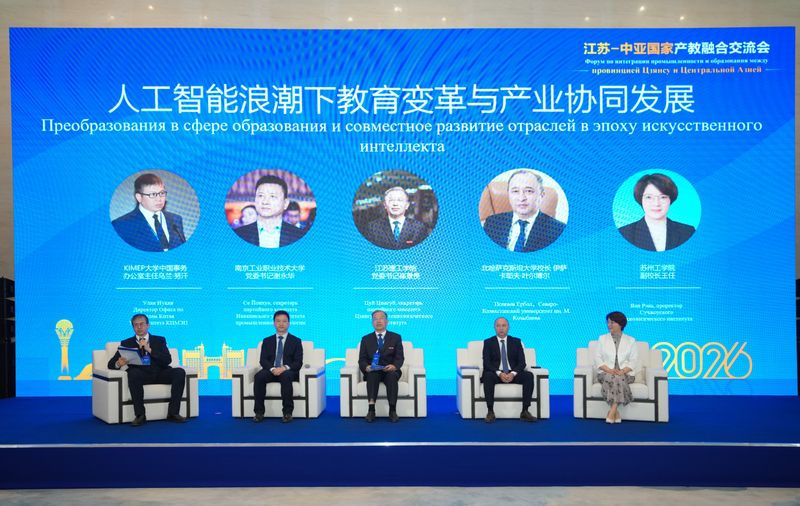
On June 12, the Jiangsu–Central Asia Countries Industry-Education Integration Exchange Conference was held in Astana, Kazakhstan. Cui Jinggui, Secretary of the Party Committee of the University, was invited to attend and delivered a keynote speech at the roundtable session. Relevant personnel from the Office of International Cooperation and Exchange, the School of International Education, the School of Culture and Tourism, and the School of Management accompanied him to the conference.
During the roundtable session, Cui Jinggui gave a detailed introduction to the University’s positioning and philosophy, an overview of Zheng He College, and the University’s practice, thinking, and pathways in actively exploring the “Chinese + Vocational Skills + Artificial Intelligence” talent training model. He pointed out that industrial direction, talent demand, and development philosophy are the core points of convergence between China and Kazakhstan, while standard co-construction, substantive school operation, and digital empowerment are the key breakthrough points for deepening cooperation. He stressed the need to leverage platforms such as the Jiangsu–Central Asia Industry-Education Integration Alliance to continuously optimize and strengthen multilateral cooperation among universities, enterprises, and local governments. The University will continue to build on its advantage as one of Jiangsu’s first batch of first-class application-oriented universities, deeply implement the “Double Excellence” project to empower industry-education integration, and take the promotion of the normalized substantive operation of Zheng He College as a key focus to further consolidate foundations, activate momentum, and broaden pathways. It will join hands with Central Asian partners to build a digital and intelligent industry-education ecosystem, enabling Jiangsu’s quality educational resources and advantageous industries to advance steadily and sustainably along the Silk Road, and contributing JSUT wisdom and strength to high-quality China-Kazakhstan cooperation.
He stated that the University will vigorously promote the China–Central Asia spirit of “mutual respect, mutual trust, mutual benefit, and mutual assistance, and advancing common modernization through high-quality development,” empower industrial development with quality education, promote people-to-people bonds through cultural exchanges, and rely on standard co-construction, talent co-cultivation, and platform sharing to strive for new breakthroughs in school operation implementation, mutual recognition of standards, and cooperation areas. It will break down cross-border barriers in professional talent training, serve Chinese-funded enterprises in Kazakhstan in a more pragmatic manner, and make application-oriented talent training more precisely aligned with the needs of intelligent upgrading of industries in Central Asia.
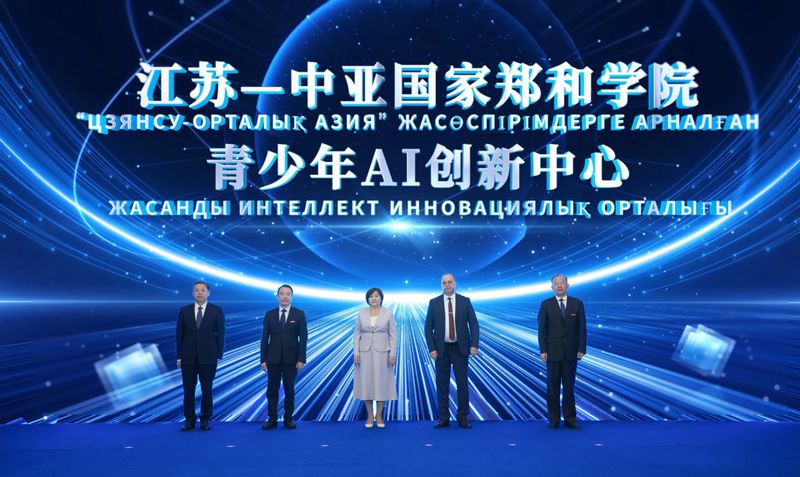
During the conference, Cui Jinggui also, on behalf of the construction unit of the Central Asia Zheng He College, together with Shynar Akparova, Vice Minister of Education of Kazakhstan, and other representatives, jointly unveiled the Jiangsu–Central Asia Countries Zheng He College Youth AI Innovation Center.
The conference was co-hosted by the Jiangsu Provincial People’s Government, the Ministry of Science and Higher Education of Kazakhstan, and the Ministry of Higher Education, Science and Innovation of Uzbekistan, and organized by the Jiangsu Provincial Department of Education and other units. Xin Changxing, Secretary of the Jiangsu Provincial Party Committee, attended and delivered a speech. Leaders from the Ministry of Science and Higher Education of Kazakhstan, the Ministry of Higher Education, Science and Innovation of Uzbekistan, the Embassy of the People’s Republic of China in Kazakhstan, and the Secretariat of the China–Central Asia Mechanism delivered speeches successively. Jiang Yong, Director of the Jiangsu Provincial Department of Education, presided over the conference and released the educational cooperation and exchange achievements between Jiangsu and Central Asian countries.